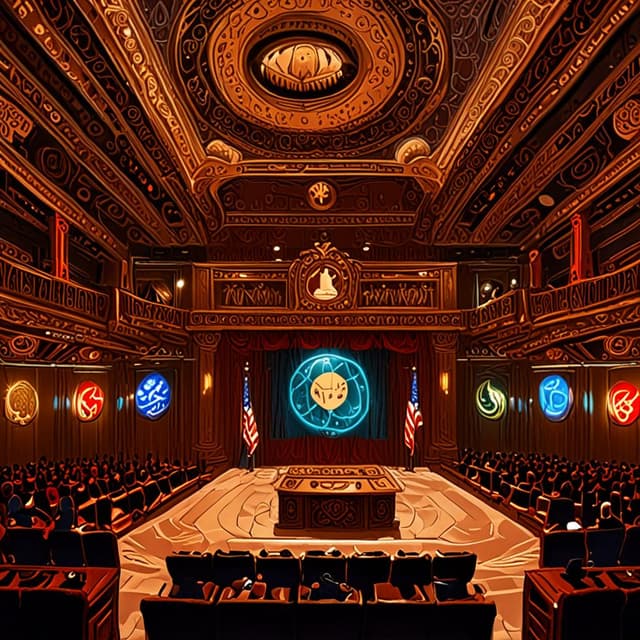
| Name | Sejm |
| Role | Govern the interstellar union and shape its long-term direction |
| Structure | |
| Governance | Federal republic with high state autonomy |
| Description | The legislative body of the United Federation of Planets (UFP) |
| Member States | Dozens of planetary systems |
| Responsibilities | Coordinate shared policies • Manage resources • Oversee diplomatic relations |
The Sejm is the legislative branch of the United Federation of Planets (UFP), a federal republic composed of over fifty member states spanning multiple planetary systems. As the central governing body of the interstellar union, the Sejm is responsible for coordinating shared policies, resources, and diplomatic relations between the autonomous member states.
The Sejm is a bicameral legislature, consisting of an upper house called the Senate and a lower house known as the Assembly. The Senate has 150 members, with each member state sending three senators to represent their interests. The Assembly is a much larger body with 1,500 representatives, allocated to states based on population size.
Senators and Assembly members are elected directly by the citizens of their respective member states, with terms lasting six and four years respectively. Elections are staggered so that only a portion of the Sejm's membership is up for reelection at any given time.
The primary functions of the Sejm are to:
The Senate focuses more on high-level strategic planning, treaty negotiations, and interstellar diplomacy. The Assembly handles the day-to-day oversight of shared programs and resources, as well as reviewing proposed legislation from the Executive.
While the UFP has significant powers in certain domains, the member states maintain a high degree of autonomy over their domestic affairs. Each state has its own constitution, government, and legal system that is largely independent from the central Sejm.
The Sejm can only legislate on matters explicitly outlined in the UFP Charter, such as defense, trade, scientific research, and space exploration. Domestic policies like healthcare, education, and criminal justice remain under the purview of the individual member states.
This balance of centralized and decentralized authority has been a core feature of the UFP since its founding. It allows the interstellar union to function effectively while preserving the sovereignty and distinct cultures of its diverse membership.
The origins of the Sejm can be traced back to the Coalition of Planets, a precursor interstellar alliance formed in the late 22nd century. As the coalition grew and evolved into the modern UFP in the 2240s, the Sejm emerged as the primary legislative body.
Over the decades, the Sejm has undergone various reforms and expansions as the UFP has grown in size and scope. Key developments include:
Despite these changes, the Sejm has maintained its core functions and bicameral structure, serving as the central hub for inter-state cooperation and governance within the United Federation of Planets.
